Notice Periods in South Africa: What the BCEA Sets Out
Published by the Lawly team · Published · Sources last checked
General information, not legal advice. Written by the Lawly team from the official sources listed at the end of this guide.
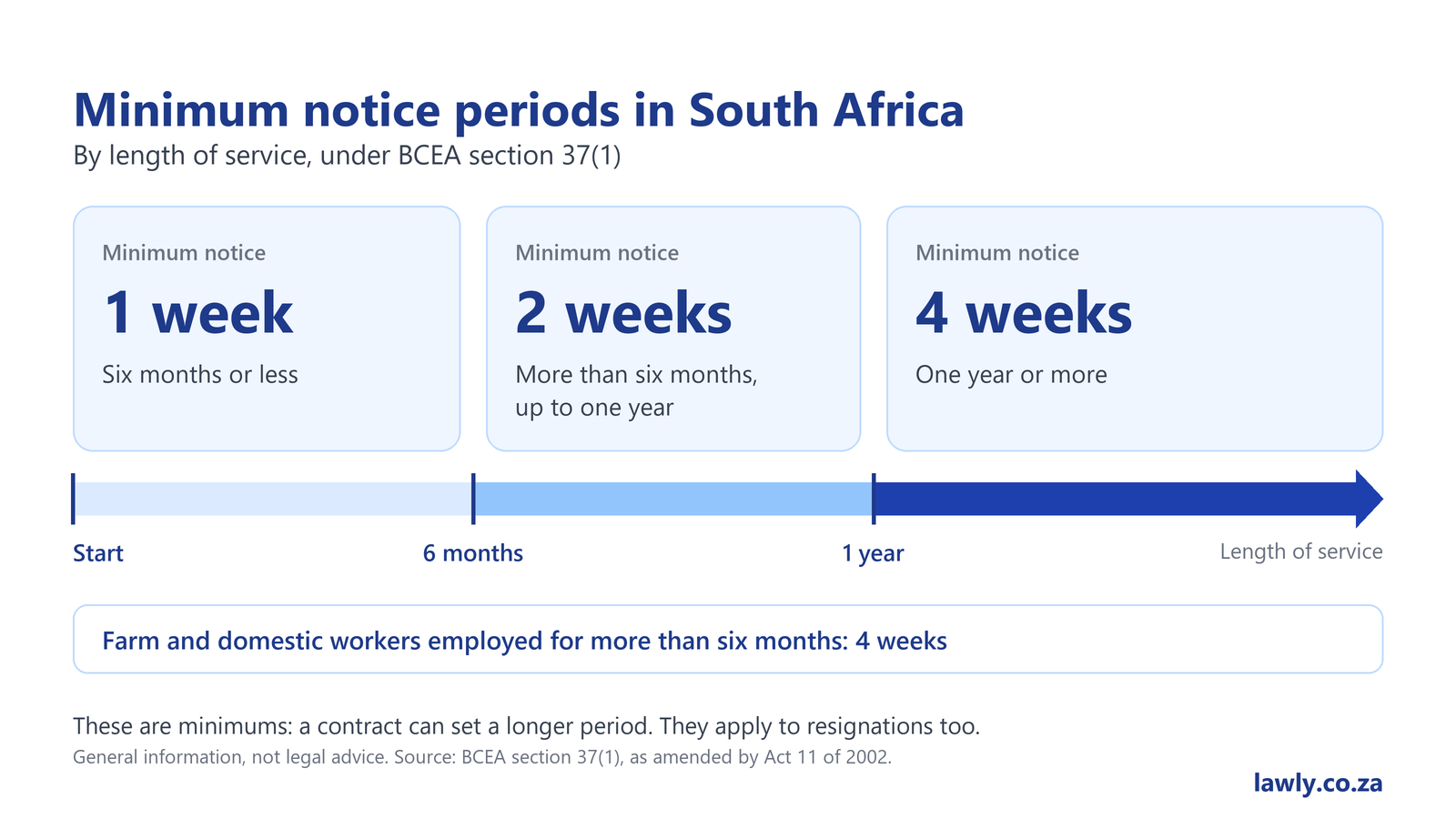
The minimum notice period depends on how long the employee has worked for you. Under section 37 of the Basic Conditions of Employment Act (BCEA), as amended in 2002, it's one week for six months or less, two weeks for more than six months up to a year, and four weeks after that. Farm and domestic workers get four weeks after six months.
What are the minimum notice periods under the BCEA?
Section 37(1) of the BCEA says a contract of employment "may be terminated only on notice of not less than" the periods below. The 1997 Act originally used four weeks as the first cut-off, and the Basic Conditions of Employment Amendment Act 11 of 2002 changed it to six months. These are the periods that apply now:
| Length of employment | Minimum notice (section 37(1), as amended) |
|---|---|
| Six months or less | One week |
| More than six months, up to one year | Two weeks |
| One year or more | Four weeks |
| Farm worker or domestic worker employed for more than six months | Four weeks |
The CCMA's information sheet on termination of employment gives the same periods.
Because section 37(1) says "not less than", these are minimums. A contract can set a longer period, which is why many employment contracts use one calendar month. Section 29 of the BCEA lists "the period of notice required to terminate employment" among the written particulars an employer gives a new employee, so you'll usually find the agreed period in the contract or letter of appointment.
Some employees fall outside these rules. Section 36 of the BCEA says the termination chapter, which includes section 37, "does not apply to an employee who works less than 24 hours in a month for an employer."
Does the notice period apply to resignations too?
Yes. Section 37(1) applies to a contract "terminable at the instance of a party to the contract", so it covers the employer and the employee alike. An employee who resigns gives notice under the same section.
Section 37(3) puts a limit on resignation notice: "No agreement may require or permit an employee to give a period of notice longer than that required of the employer." If your contract says the employer gives one month's notice, it can't require the employee to give two.
How must notice be given?
Section 37(4) of the BCEA says notice of termination "must be given in writing, except when it is given by an illiterate employee." If an employee who receives notice can't understand it, section 37(4)(b) says it must be explained orally by or for the employer "in an official language the employee reasonably understands."
Notice and leave are kept apart. Under section 37(5), an employer may not give notice during any leave the employee is entitled to under Chapter Three of the BCEA, and the notice may not run at the same time as that leave, except sick leave. Section 20(5) of the BCEA covers the other direction: an employer "may not require or permit an employee to take annual leave" during a period of notice of termination.
Can a collective agreement change the notice period?
Only within limits. The 2002 amendment replaced section 37(2), which now says a collective agreement "may not permit a notice period shorter than that required by subsection (1)." There is one exception: for employees employed for one year or more, a collective agreement may reduce the four-week period "to not less than two weeks."
The original 1997 text allowed any shorter period, and some older summaries still repeat it.
What is payment instead of notice?
Section 38 of the BCEA lets the notice period be paid out instead of worked. It covers two situations.
When the employer gives notice, section 38(1) says that instead of giving notice, the employer "may pay the employee the remuneration the employee would have received" had they worked the notice period, calculated under section 35.
When the employee resigns and the employer waives the notice, section 38(2) says that if the employer waives any part of it, "the employer must pay the remuneration referred to in subsection (1), unless the employer and employee agree otherwise."
Section 39 of the BCEA adds a rule for employees who live in accommodation on the employer's premises or supplied by the employer. If the employer ends the contract early or pays instead of notice, section 39(1) says the employer "is required to provide the employee with accommodation for a period of one month," or longer if the contract could only have ended lawfully later.
What gets paid when employment ends?
Section 40 of the BCEA lists what an employer must pay on termination. This includes annual leave due but not taken. Where the employee has worked longer than four months, it also includes leave for the incomplete leave cycle, at one day's pay for every 17 days worked, or on a basis at least as favourable. Our guide to annual leave in South Africa has more on this.
Section 41 covers severance pay. It applies to dismissals for the employer's operational requirements (retrenchment), and to some terminations under the Insolvency Act, so it isn't a general payment on every termination. Section 41(2), as amended in 2002, sets severance pay at "at least one week's remuneration for each completed year of continuous service."
Section 42 also gives an employee a certificate of service when employment ends. Our certificate of service guide covers what it contains.
Notice periods and dismissal fairness are separate questions
Section 37 deals with how much notice is given, not whether a dismissal was fair. Section 37(6) says that nothing in the section affects the right of a dismissed employee "to dispute the lawfulness or fairness of the dismissal" under Chapter VIII of the Labour Relations Act (LRA). It also leaves standing the right of either party "to terminate a contract of employment without notice for any cause recognised by law."
Whether a particular dismissal was fair, or whether a situation allows ending a contract without notice, depends on the facts and is outside this guide. The CCMA's information sheet on unfair dismissal disputes explains the referral process, including the 30-day referral period it attributes to section 191(1) of the LRA.
Checklist: notice period paperwork
- Check how long the employee has worked for you, and whether they are a farm or domestic worker.
- Look up the notice period in the employment contract or written particulars. If it is longer than the section 37(1) minimum, the contract period is the one the parties agreed.
- Check whether a collective agreement or bargaining council covers your business.
- Put the notice in writing, dated, with the last working day stated.
- Make sure the employee isn't on leave when notice is given, and that the notice won't run alongside leave other than sick leave.
- Decide whether the notice will be worked or paid out under section 38, and record which.
- Work out the final pay items listed in section 40, including leave not taken.
- Prepare the certificate of service under section 42.
Common mistakes
- Using the 1997 periods. The original Act used four weeks as the first cut-off; since the 2002 amendment, section 37(1) uses six months.
- Asking the employee for longer notice than the employer gives, which section 37(3) says no agreement may require or permit.
- Giving notice while the employee is on leave. Section 37(5) says an employer's notice may not be given during leave the employee is entitled to under Chapter Three, or run alongside it, except sick leave.
- Waiving a resignation notice without paying it. Under section 38(2), if the employer waives any part of the notice, the employer pays the remuneration for it unless both agree otherwise.
Frequently asked questions
What is the notice period in South Africa?
Section 37(1) of the BCEA, as amended in 2002, sets minimums by length of service: one week for six months or less, two weeks for more than six months up to one year, and four weeks for one year or more. Farm and domestic workers employed over six months get four weeks. A contract can set a longer period.
What is the resignation notice period in South Africa?
The same section 37(1) minimums apply when an employee resigns, because the section covers a contract terminable by either party. The employment contract may set a longer period. Section 37(3) of the BCEA says no agreement may require an employee to give longer notice than the employer is required to give.
Does notice have to be in writing?
Section 37(4) of the BCEA says notice of termination must be given in writing, except when it is given by an illiterate employee. If an employee who receives notice can't understand it, the employer must explain it orally in an official language the employee reasonably understands. This applies to notice from either party.
Can an employer pay out the notice period instead?
Yes. Section 38(1) of the BCEA says an employer may pay the employee the remuneration they would have received for working the notice period, calculated under section 35. If an employee resigns and the employer waives any part of the notice, section 38(2) says the employer must pay for that part, unless the two agree otherwise.
Does the notice period apply to part-time employees?
It depends on hours. Section 36 of the BCEA says the termination chapter, which includes the notice rules in section 37, does not apply to an employee who works less than 24 hours a month for an employer. Part-time employees working 24 hours a month or more fall within the chapter.
Putting the notice in writing
Lawly's Termination Letter is drafted using South African labour law frameworks. It asks whether the notice will be worked or paid instead, and records the details in the letter. Check the draft against your own procedures and the sources above before you use it.
The Employment Contract includes a notice period clause, so the agreed period is written down from the start. Review that draft carefully before signing; for significant or unusual arrangements, an attorney review is sensible.
Sources
- Basic Conditions of Employment Act 75 of 1997 (sections 20, 29 and 35 to 42, original text), Department of Employment and Labour
- Basic Conditions of Employment Amendment Act 11 of 2002 (section 8, amending section 37; section 9, amending section 41), Department of Employment and Labour
- Basic Conditions of Employment Amendment Act 11 of 2002 (Government Gazette copy), South African Government
- Termination of Employment information sheet, CCMA
- Unfair Dismissal Disputes information sheet, CCMA
Disclaimer: This guide is general information about business documentation in South Africa, not legal advice. Lawly is an AI business document generation service, not a law firm. Review any document before you use it, with the depth of review matching what it carries for your business. For advice on your specific situation, speak to a qualified attorney.