Registering as an Employer in SA: UIF, COIDA and PAYE
Published by the Lawly team · Published · Sources last checked
General information, not legal advice. Written by the Lawly team from the official sources listed at the end of this guide.
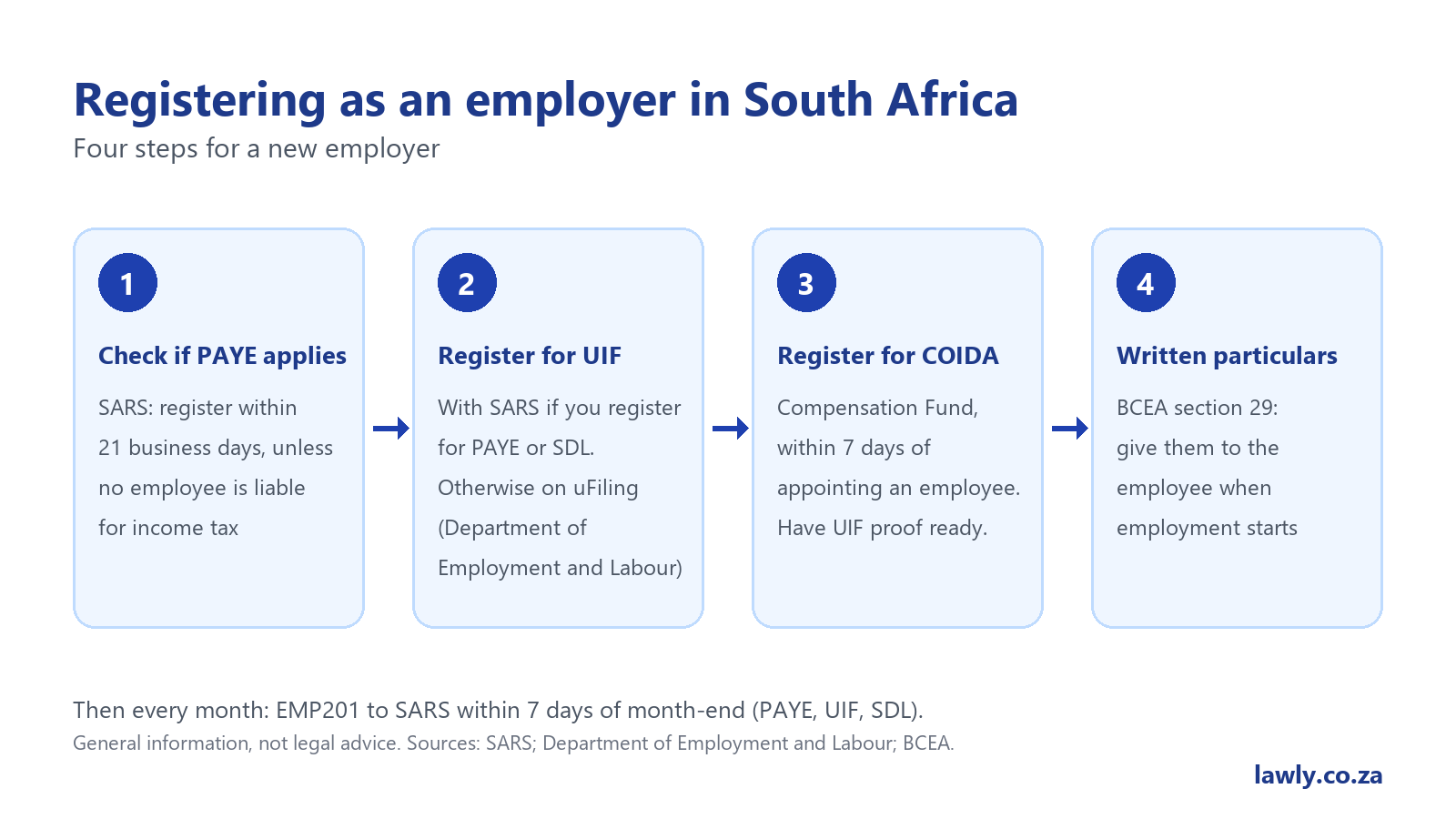
When you take on your first employee in South Africa, you may have to register in up to three places. SARS handles PAYE, plus UIF and the Skills Development Levy where they apply. If you don't register with SARS, you register for UIF on uFiling instead. COIDA registration goes to the Compensation Fund. The Department of Employment and Labour gives you 7 days for COIDA; SARS gives you 21 business days for PAYE.
Which registrations apply to you?
Mostly, it depends on what your employees earn.
PAYE (employees' tax). SARS states that "an employer must register with the South African Revenue Service (SARS) within 21 business days after becoming an employer, unless none of the employees are liable for normal tax." So if at least one employee earns enough to pay income tax, you register for PAYE.
UIF (Unemployment Insurance Fund). According to SARS, an employer who registers with SARS for PAYE or the Skills Development Levy also registers with SARS to pay UIF contributions. If you don't need to register with SARS for either, you register for UIF directly with the Unemployment Insurance Fund. SARS lists employees who work fewer than 24 hours a month among those excluded from UIF contributions.
SDL (Skills Development Levy). SARS says an employer becomes liable for SDL "where an employer expects that the total salaries will be more than R500 000 over the next 12 months." Below that, you don't pay the levy.
COIDA (Compensation Fund). The Department of Employment and Labour states that "an employer must register with the Compensation Fund (CF) within 7 [days] after appointing an employee/s." This one doesn't depend on whether your employees pay tax.
Why the order matters
COIDA has the shortest deadline of the three (7 days), and the Department lists UIF proof of registration among the documents the Compensation Fund asks for. In practice, that means sorting out UIF first, so you have the proof in hand when you register with the Compensation Fund.
If you're registering with SARS for PAYE, UIF is part of the same SARS registration. If you aren't, register for UIF on uFiling first.
How to register for PAYE (and UIF and SDL) with SARS
SARS publishes a step-by-step guide to registering for PAYE on eFiling. In outline:
- Log in to eFiling and open your SARS registered details.
- Add a new product registration and complete the RAV01 form, selecting the payroll taxes that apply.
- Select your business activity code and submit.
- Watch your eFiling correspondence. If SARS sends a Registration Application Review Notice asking for supporting documents, the guide says to submit them within 21 days.
Once you're registered, SARS issues an employer reference number, which you use on every monthly return.
How to register for UIF on uFiling
If you aren't registering with SARS, you use the Department of Employment and Labour's uFiling portal, where employers "register, declare and pay UIF contributions." Employers of domestic workers often go this route.
You'll need the employer's details and at least one employee, looked up by ID number. Once the application is processed, the Department emails you a UI reference number. The Department's uFiling user guide walks through each screen.
According to SARS, UIF is 1% of remuneration from the employee and 1% from the employer, 2% in total. Contributions are capped at a monthly earnings ceiling, which the Minister adjusts from time to time. When we last checked, SARS listed the ceiling as R17,712 a month (in effect since 1 June 2021), so the most you could deduct from an employee was R177.12 a month. Check SARS's UIF page for the current figure.
How to register with the Compensation Fund (COIDA)
The Department of Employment and Labour's page on Compensation Fund obligations of the employer lists what to have ready:
- CIPC registration certificate (for a company)
- UIF proof of registration
- ID copies of the owners or directors
- Proof of business address
- For sole traders: UIF proof and proof of business address
The Department prefers online registration through ROE Online. Once you're approved, you receive a Compensation Fund contract number.
After that, the Department requires an annual Return of Earnings, submitted within the window the Compensation Fund announces each year. Its page warns that late submission attracts interest and penalties.
Registration checklist
- Check whether any employee is liable for income tax. If so, register for PAYE on eFiling within 21 business days of becoming an employer.
- Register for UIF: through SARS if you're registering for PAYE or SDL, otherwise on uFiling.
- Register with the Compensation Fund within 7 days of appointing your first employee, with your UIF proof of registration ready.
- Check whether your total salaries will exceed R500,000 over the next 12 months. If so, register for SDL.
- Give your employee the written particulars of employment when they start (see below).
- If you employ five or more people, set up payroll so each payslip carries the information listed in section 33 of the BCEA (section 28(2) exempts smaller employers).
What you file every month and every year
Monthly: EMP201. SARS asks employers to submit the EMP201 declaration, with payment, "within 7 days after the end of each month." It covers PAYE, UIF, SDL and the Employment Tax Incentive. SARS has a guide to completing the EMP201. If you're registered for UIF only, on uFiling, you declare and pay your UIF contributions there instead.
Twice a year: EMP501. SARS runs two reconciliation periods each tax year:
- an interim reconciliation covering March to August, roughly in September and October
- an annual reconciliation covering the full tax year (March to February), roughly in April and May
These are approximate. SARS publishes the exact submission dates each year, so confirm them on its reconciliations page before you plan around them. Employee tax certificates (IRP5 or IT3(a)) are issued as part of the reconciliation.
Annually: Return of Earnings to the Compensation Fund, as above.
The paperwork on day one
Registering isn't the only thing a new employer has to do. Section 29 of the Basic Conditions of Employment Act (BCEA) says an employer must supply an employee "when the employee commences employment" with written particulars of employment: the employer's details, the employee's job, hours, pay and deductions, leave and notice period, among others. Most employers put these into a written employment contract. Our guide to what should be in an employment contract lists them.
Two other BCEA sections deal with payroll, but they may not apply to you. Section 28(2) of the BCEA says sections 31 and 33 (and some of the section 29 particulars) do not apply to "an employer who employs fewer than five employees". If you employ five or more people:
- section 33 lists the information an employer must give the employee in writing on each payday, including the period paid for, remuneration, the amount and purpose of each deduction, and the actual amount paid
- section 31 requires a record of each employee's time worked and remuneration, kept for three years from the date of the last entry
Section 28(1) adds that this part of the BCEA doesn't apply to an employee who works less than 24 hours a month for an employer. Even if you're a smaller employer, payslips and payroll records are worth keeping, because your EMP201 and EMP501 figures have to come from somewhere.
Common mistakes
- Registering for PAYE but forgetting the Compensation Fund. SARS registration doesn't cover COIDA, which is a separate registration with its own 7-day deadline.
- Assuming no PAYE means nothing to register. Even if none of your employees pays income tax, UIF registration (on uFiling) and Compensation Fund registration can still apply.
- Leaving UIF until after COIDA. The Compensation Fund asks for UIF proof of registration, so doing UIF first saves a second round of paperwork.
- Missing the EMP201 date. It's due every month within 7 days of month-end, even when there's little to declare.
- Not updating the written particulars. Section 29 of the BCEA says that when any of the particulars change, the written particulars must be revised and the employee given a copy.
Frequently asked questions
How long do I have to register for UIF?
SARS links UIF registration to PAYE and SDL: if you register with SARS for either, you register for UIF in the same process, and PAYE registration is due within 21 business days of becoming an employer. Employers not registered with SARS register directly on uFiling. For UIF-only registrations, check the current requirements with the Department of Employment and Labour.
What is the deadline for COIDA registration?
The Department of Employment and Labour states that an employer must register with the Compensation Fund within 7 days after appointing an employee. The Department prefers online registration through ROE Online, and the Fund asks for UIF proof of registration, among other documents.
Do I need to register for PAYE if my employee earns below the tax threshold?
SARS says an employer must register within 21 business days of becoming an employer "unless none of the employees are liable for normal tax." If no employee is liable, you don't need to register for PAYE. UIF and the Compensation Fund are separate and may still apply.
How much is UIF?
According to SARS, UIF contributions are 1% of the employee's remuneration plus 1% from the employer, 2% in total. Contributions are capped at a monthly earnings ceiling that changes from time to time: R17,712 when we last checked, which made the maximum employee deduction R177.12 a month. SARS's UIF page has the current figure.
Do I have to pay the Skills Development Levy?
SARS says an employer becomes liable for SDL when total salaries are expected to exceed R500,000 over the next 12 months. The levy is 1% of total salaries, declared on the monthly EMP201.
Getting the employment paperwork in place
With the registrations done, the next step is the written particulars your employee receives on their first day. Lawly's Employment Contract is drafted using South African labour law frameworks, with sections for the particulars listed in section 29 of the BCEA. Check the draft against section 29 and your own arrangements before signing. For significant or unusual arrangements, such as senior roles or restraint of trade clauses, an attorney review is sensible.
Sources
- Registering for Employees' Tax (PAYE), SARS
- How to register for PAYE on eFiling, SARS
- Unemployment Insurance Fund (UIF), SARS
- Skills Development Levy (SDL), SARS
- Completing the monthly employer declaration (EMP201), SARS
- PAYE reconciliations (EMP501), SARS
- uFiling, Department of Employment and Labour
- uFiling System User Guide, Department of Employment and Labour
- Compensation Fund: obligations of the employer, Department of Employment and Labour
- ROE Online, Compensation Fund
- Basic Conditions of Employment Act 75 of 1997 (sections 28, 29, 31 and 33), Department of Employment and Labour
- Basic Conditions of Employment Amendment Act 11 of 2002 (section 5, amending section 28), Government of South Africa
Disclaimer: This guide is general information about business documentation in South Africa, not legal advice. Lawly is an AI business document generation service, not a law firm. Review any document before you use it, with the depth of review matching what it carries for your business. For advice on your specific situation, speak to a qualified attorney.