How Many Warnings Before Dismissal in South Africa?
Published by the Lawly team · Published · Sources last checked
General information, not legal advice. Written by the Lawly team from the official sources listed at the end of this guide.
The Code of Good Practice: Dismissal doesn't set a number. The 2025 Code, issued under the Labour Relations Act, says repeated misconduct "will warrant warnings" and that more serious or repeated misconduct "may call for a final warning or dismissal". Under item 7(2), serious misconduct can also be a single instance.
Which Code applies now?
The Code of Good Practice: Dismissal was published as General Notice 3470 in Government Gazette 53294 on 4 September 2025. The notice says the Minister of Employment and Labour issued it under section 203(2A) of the Labour Relations Act (LRA), "to take effect on the date of publication of this Code."
The same notice says the publication "repeals Schedule 8 Code of Good Practice on Dismissal" and the 1999 Code of Good Practice on dismissal for operational requirements. Many older articles and templates quote Schedule 8 item numbers. The item numbers in this guide are from the 2025 Code.
The Code describes itself as guidance. Item 1 says it "provides guidance to employers, employees, trade unions and persons applying the Code on how the legal obligations under the Act regarding dismissals for misconduct, incapacity and operational requirements apply". Item 2(1) adds that it "is intentionally general" and that departures from its norms "may be justified in proper circumstances."
What does the Code say about warnings?
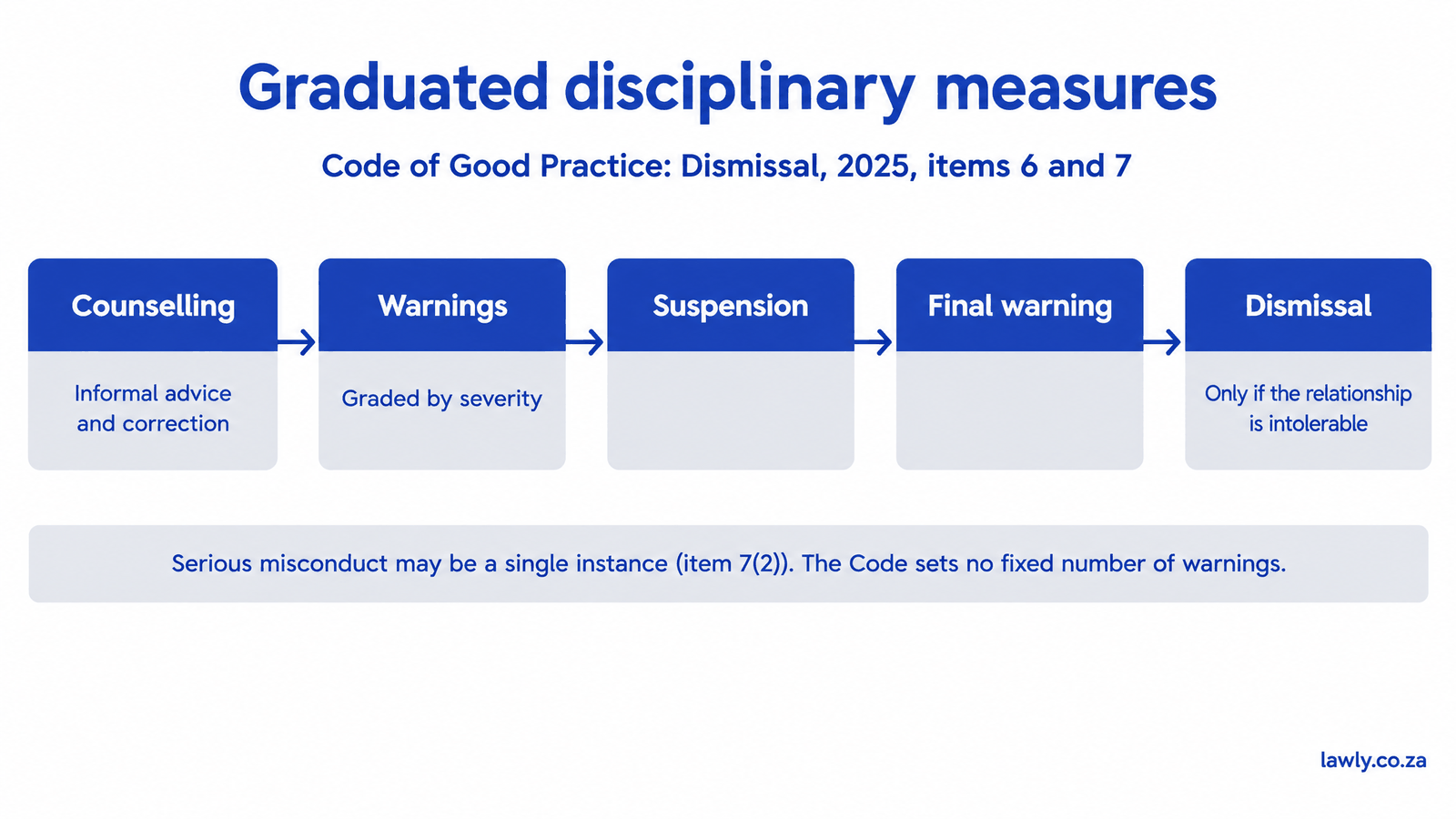
Item 6 of the Code deals with disciplinary measures. Item 6(2) says the purpose of disciplinary processes "is corrective. They are primarily a means to correct an employee's behaviour through graduated disciplinary measures."
A footnote to item 6(2) lists what those measures can be: "Graduated disciplinary measures may, depending on the circumstances, include counselling, warnings, suspension and a final warning."
Item 6(6) is the passage that answers the question most directly:
"Formal procedures do not have to be invoked every time a rule is broken, or a standard is not met. Informal advice and correction is often the best and most effective way for an employer to deal with minor violations of work discipline. Repeated misconduct will warrant warnings, which themselves may be graded according to degrees of severity. More serious infringements or repeated misconduct may call for a final warning or dismissal."
The Code doesn't say how many steps there must be, or how many warnings come before a final one. The term "progressive discipline" appears once, in item 9(3), which lists "whether progressive discipline might prevent a recurrence of the misconduct" as a factor when deciding whether dismissal is appropriate.
Can an employee be dismissed for a first offence?
The Code allows for it in cases of serious misconduct. Item 7(1) says an employee "may be dismissed for serious misconduct if the misconduct renders the continuation of the employment relationship intolerable."
Item 7(2) goes on: "Subject to the rule that each case should be judged on its merits, serious misconduct may be a single instance of misconduct or repeated misconduct where graduated disciplinary measures have been implemented."
The Code doesn't give a list of offences that count as serious. Whether particular conduct is serious enough depends on the facts, and that isn't something this guide can answer.
According to item 9, "Generally, dismissal is only an appropriate sanction if a continued employment relationship is intolerable." The item then lists the factors to consider:
- "the nature and requirements of the job;"
- "the nature and seriousness of the misconduct and its effect on the business;"
- "whether progressive discipline might prevent a recurrence of the misconduct;"
- "any acknowledgement of wrongdoing by the employee and willingness to comply with the employer's rules and standards; and"
- "the employee's circumstances (including length of service, disciplinary record and the effect of dismissal on the employee)."
What should be considered before deciding on a sanction?
Item 8 of the Code sets out what "any person who is deciding whether a sanction for misconduct is fair should consider". Put as questions:
- Did the employee contravene a rule or standard regulating conduct in, or relevant to, the workplace?
- Was the rule valid and reasonable?
- Was the employee aware of it, or could they reasonably be expected to have been aware of it?
- How important is the rule in the workplace?
- What actual or potential harm did the contravention cause?
- Has the employer applied the rule consistently?
- Is dismissal an appropriate sanction for the contravention?
Consistency over time comes up again in item 10, which says that "as a general rule, the employer should apply the sanction of dismissal in the same way in which it has been applied to other employees in the past", and consistently between employees involved in the same misconduct. A footnote qualifies this: inconsistency "does not necessarily mean that the dismissal is unfair if the misconduct renders the continuation of the employment relationship intolerable."
What does a fair procedure look like?
Item 5(1) of the Code says a dismissal is fair "if it is for a fair reason and in accordance with a fair procedure." Item 11 describes the procedure. Its stated purpose "is to ensure a genuine dialogue and an opportunity for reflection before any decision is taken."
Item 11(3) says an investigation or enquiry "does not have to be formal". Item 11(4) lists what usually happens before a decision to dismiss. The employee should be:
- "notified of the allegations of misconduct, preferably in writing;"
- "given an opportunity within a reasonable period of time to prepare and make representations on both the misconduct allegations and the appropriate sanction;"
- "allowed the assistance of a fellow employee or trade union representative;"
- "where reasonably possible, provided with the opportunity to converse in a language that the employee is comfortable with."
Under item 11(6), an employer that "cannot reasonably be expected to comply with these guidelines" may dispense with some or all of them in exceptional circumstances. The same item says the employer "may be obliged to justify non-compliance" if the employee refers a dispute about procedural fairness.
What changes for a small business?
Item 3(1) says the Code "should not be interpreted as requiring small businesses to comply with obligations that are not practical or feasible for their operation."
Item 3(3) gives the reason: "small businesses cannot reasonably be expected to engage in time-consuming investigations or pre-dismissal processes while at the same time keeping the business going." It also notes that small employers "do not have human resource departments staffed by people with skills and experience in these matters."
Part D makes the same allowance in two places. Item 6(3) says "smaller employers may adopt a less formal approach to discipline", and item 11(3) says the nature of an enquiry should suit "the nature and size of the employer". These items deal with how formal the process is. Item 5(1) still describes a fair dismissal as one for a fair reason and in accordance with a fair procedure.
How long does a warning stay valid?
The Code doesn't set a period. Items 6 to 13 say nothing about how long a warning counts against an employee.
The nearest it comes is on rules and records. Item 6(4) says disciplinary rules and procedures "should be clear and made available to employees in a manner that is easily understood." Item 13 says employers "should keep records for each employee specifying the nature of any disciplinary transgressions, the actions taken by the employer and the reasons for the actions." If your business uses a validity period, writing it into your disciplinary rules and into each warning keeps it clear to the employee.
Checklist: warning paperwork
- Write down the rule or standard the employee broke, and how they knew about it.
- Record the facts: dates, what happened, and who was involved.
- Give the employee a chance to respond before deciding on a warning, and note what they said.
- Choose the level of warning, keeping item 6(6) in mind: informal correction for minor issues, graded warnings for repeated misconduct.
- State the improvement expected and what may follow if the misconduct is repeated.
- State how long the warning remains on record, if your rules use a validity period.
- Give the employee a copy, and keep the record that item 13 describes.
- Before any dismissal, check the item 8 questions and the item 11(4) procedure.
Common mistakes
- Treating "three warnings" as a legal rule. The Code doesn't set a number; item 6(6) describes graded warnings and item 7(2) allows for a single instance of serious misconduct.
- Quoting Schedule 8. The 2025 Code repealed it, and its item numbers differ.
- Skipping the employee's side. Item 11(2) describes a fair procedure as one where the employee had "an adequate and reasonable opportunity to respond to the allegation of misconduct."
- Applying rules unevenly. Items 8 and 10 both raise consistency.
- Keeping no records. Item 13 says employers should keep a record of each transgression, the action taken and the reasons.
Frequently asked questions
How many warnings before dismissal in South Africa?
The Code of Good Practice: Dismissal (2025) doesn't set a number. Item 6(6) says repeated misconduct will warrant warnings, which may be graded by severity, and that more serious or repeated misconduct may call for a final warning or dismissal. Item 7(2) says serious misconduct may be a single instance, judged on its merits.
Do you need a final written warning before dismissal?
The Code doesn't say a final warning is always needed. Item 6(6) says more serious infringements or repeated misconduct "may call for a final warning or dismissal", and item 7(2) allows dismissal for a single instance of serious misconduct. Whether dismissal is fair in a particular case depends on the facts, which the CCMA or an attorney can assess.
How long is a written warning valid in South Africa?
The 2025 Code of Good Practice: Dismissal doesn't set a validity period for warnings. Item 6(4) says disciplinary rules should be clear and made available to employees, and item 13 says employers should keep records of transgressions and the action taken. A validity period, if used, would come from the employer's own disciplinary rules.
Does the Code still apply to small businesses?
Yes, with allowances. Item 3 of the Code says it shouldn't be read as requiring small businesses to meet obligations that aren't practical for them, and that small businesses can't reasonably be expected to run time-consuming investigations. Item 6(3) says smaller employers may adopt a less formal approach to discipline.
What can an employee do if they think a dismissal was unfair?
The CCMA's Unfair Dismissal Disputes information sheet says section 191(1) of the LRA requires an employee disputing a dismissal to refer it in writing to a bargaining council or the CCMA within 30 days of the dismissal. The same sheet quotes section 192(2): the employer "must prove that the dismissal is fair."
Putting a warning in writing
Lawly's Warning Letter is drafted using South African labour law frameworks. It asks for the warning level (a record of a verbal warning, a first written warning or a final written warning), the rule that was broken, whether a discussion was held first, the improvement expected and how long the warning stays valid.
If the process ends in a dismissal, the Termination Letter records the decision and the notice details, and our guide to notice periods in South Africa covers the notice side. Check either draft against your own procedures and the sources above before you use it.
Sources
- Code of Good Practice: Dismissal, 2025 (General Notice 3470, Government Gazette 53294, 4 September 2025), South African Government
- Code of Good Practice: Dismissal, 2025 (same Gazette, with document details), Laws.Africa / LawLibrary
- Unfair Dismissal Disputes information sheet (CCMA-I849-2025-01), CCMA
Disclaimer: This guide is general information about business documentation in South Africa, not legal advice. Lawly is an AI business document generation service, not a law firm. Review any document before you use it, with the depth of review matching what it carries for your business. For advice on your specific situation, speak to a qualified attorney.